

| Undersized Risk | Oversized Risk |
|---|---|
| Workloads do not receive enough resources to run safely, creating performance and reliability risk. | Idle capacity waste and reduced cluster utilization. |
| Undersized memory limits can cause OOM kills. | Increased probability of pending pods. |
| CPU Throttling and degraded application performance. | Failed deployments caused by resource fragmentation. |
| Node overcommitment, leading to unstable scheduling behavior and capacity contention. | Autoscaler thrashing from inefficient scheduling pressure. |
Container Optimization Workflow
1. Container Telemetry Collection
Kubex continuously collects raw operational data from Kubernetes containers, including:- CPU utilization
- Memory utilization
- Resource requests
- Resource limits
- Replica behavior
- Scaling activity
- OOM kill events
- Runtime utilization trends
2. Usage Pattern Analysis
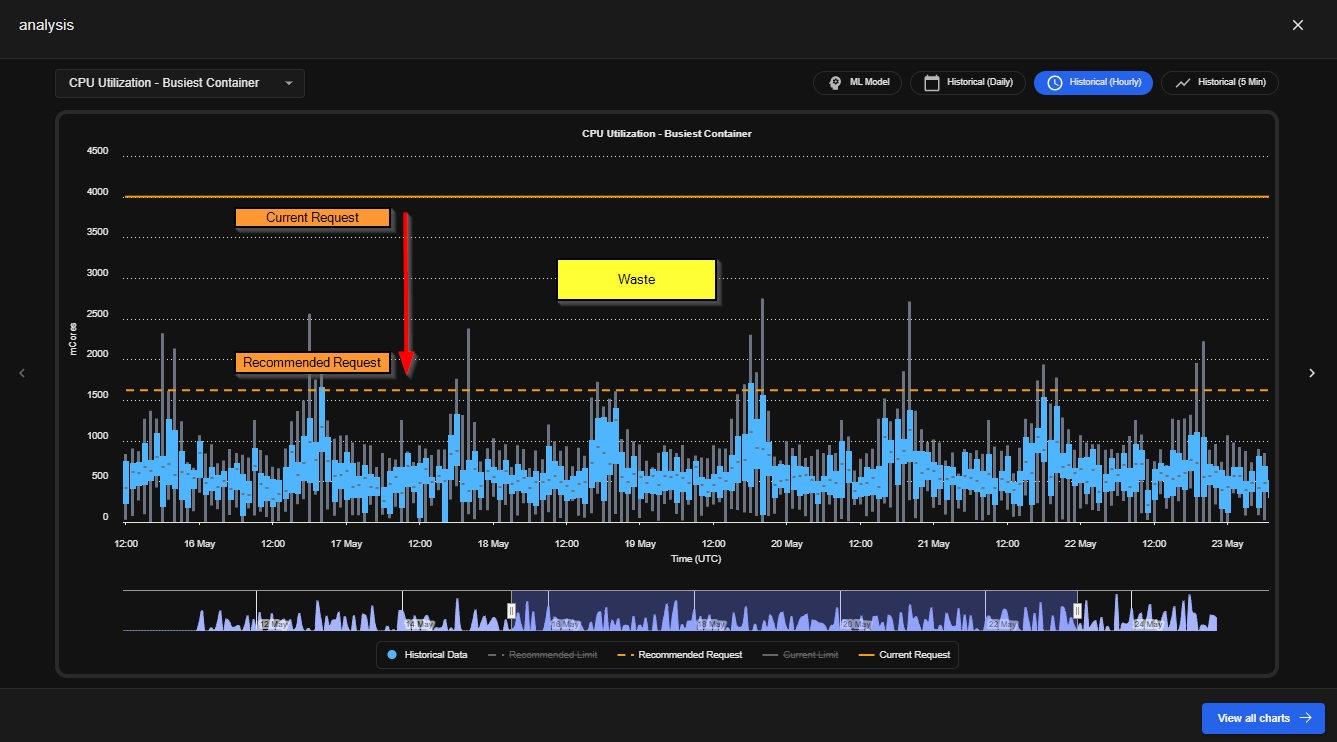
Kubex applies machine learning models to identify workload behavior patterns over time. The analysis includes:Historical Resource Consumption
Evaluates:- Average utilization
- Peak utilization
- Sustained demand
- Burst patterns
- Idle periods
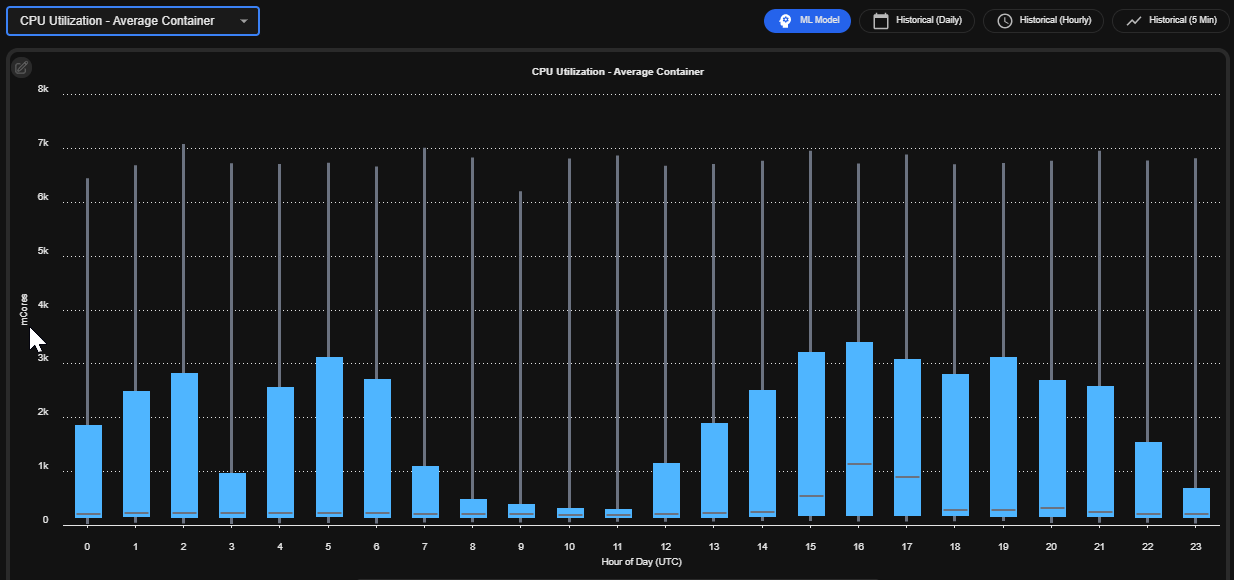
Temporal Workload Behavior
Analyzes:- Time-of-day usage
- Daily and weekly cycles
3. Policy-Based Optimization
Kubex combines machine learning analysis with configurable operational policies. Policies allow teams to control:- Optimization aggressiveness
- Minimum headroom requirements
- Downsizing behavior
- Upsizing sensitivity
- Environment-specific standards
- Assignment of policies to clusters, namespace or label-based
4. Scientific Rightsizing Recommendations
Based on workload analysis and policy evaluation, Kubex generates optimized recommendations for:- CPU Limit & Request
- Memory Limit & Request
- Ephemeral Storage Limit & Request
- GPU fractional recommendations and optimal MIG profile. See GPU Optimization
- Eliminate wasted capacity
- Maintain workload stability
- Improve scheduler efficiency
- Reduce infrastructure cost
Key Benefits of Kubex Container Analysis
| Capability | Benefit |
|---|---|
| ML-Based Workload Analysis | Accurate resource sizing based on real behavior |
| Policy-Driven Optimization | Aligns recommendations with operational goals |
| Replica-Aware Analysis | Detects workload-wide inefficiencies |
| Continuous Reassessment | Adapts to changing workload demands |
| Kubernetes-Aware Safety Checks | Reduces operational risk |
| Automated Rightsizing | Eliminates manual tuning effort |
| Explainable Recommendations | Builds trust with platform and application teams |